
Care at the Block Level
How HECMR is using artificial intelligence, weather data, and traffic data to improve decision making on Long Island.

The Problem
When looking at health disparities between communities, the zip code model doesn’t match the realities of Long Island. These postal codes were made decades ago, and communities have changed between people moving to the Island and the repurposing of agricultural land.
We needed a new way to look at health disparities with richer information that better incorporates where people actually live, the infrastructure challenges we face, and the changes to our climate.
Lessons from Los Angeles
Across the country, Stony Brook Alumnus and Anesthesiologist Dr. Jonathan Tan faced a similar challenge while working at Children’s Hospital of Los Angeles. He noticed that some of his patients from specific areas were at greater risk of respiratory complications from anesthesia even if they didn’t have a respiratory disease.
Dr. Tan and his team developed a HIPAA-compliant tool that allowed them to connect AccuWeather data with patient data to see how environmental exposures impacted their patients’ health. They were able to do this across their health system population, giving healthcare providers and patients better intervention options to improve health outcomes.
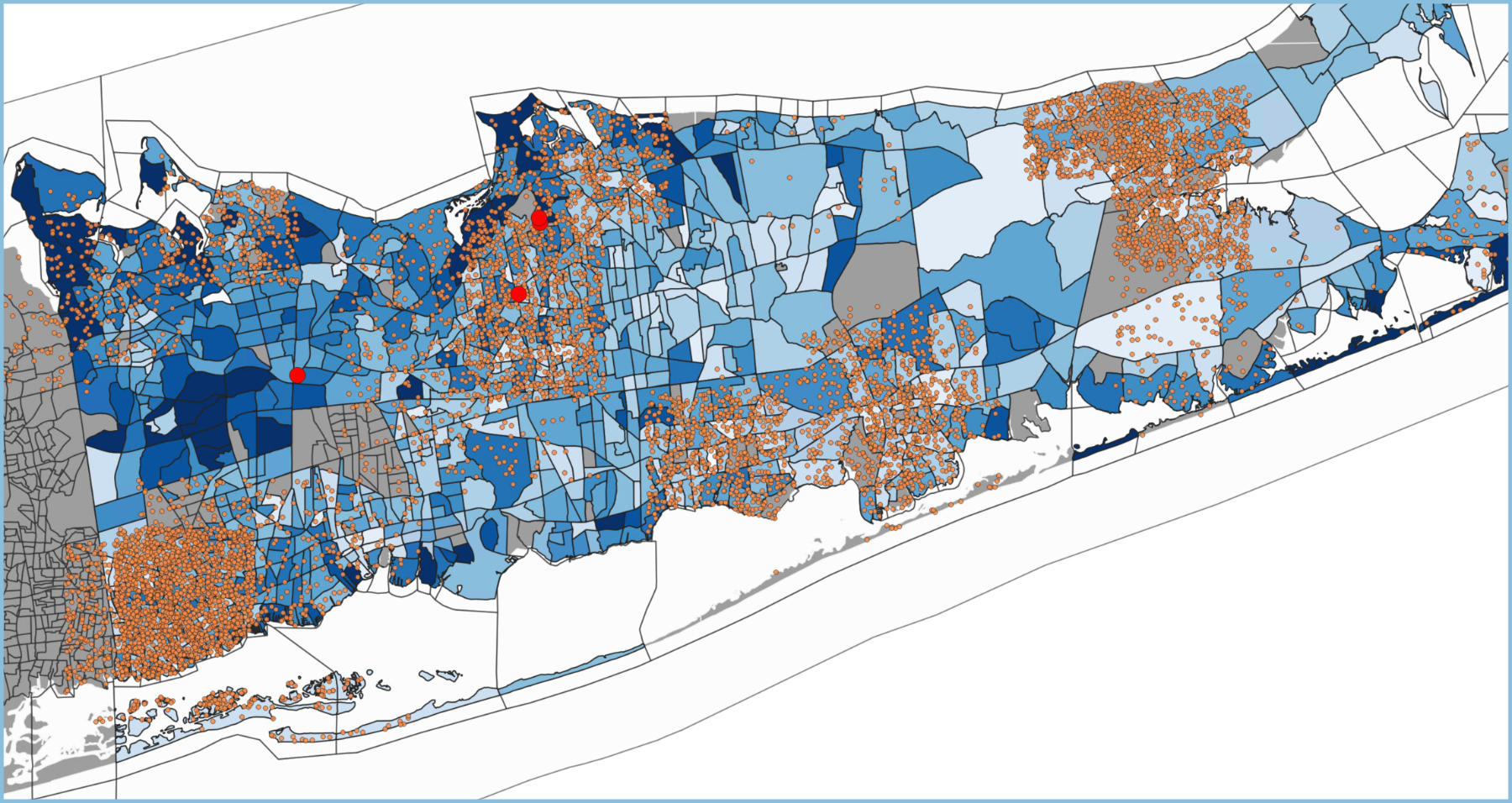
An early model of the maps using mock patient data with the underlying per capita income per census block.
Block-Level Data for Better Decisions
The Stony Brook Office of Health Equity and Climate Medicine Research (HECMR) saw an opportunity to adapt this tool to Long Island and build upon this existing model. Through a partnership between Stony Brook Medicine (SBM) and Dr. Tan’s team—now at Children’s Hospital of Philadelphia (CHOP)—we are developing a series of HIPAA-Compliant dashboards to help hospital decisionmakers, local policymakers and community leaders make better decisions about how we bring additional resources and health care to Long Island.
This tool will use census-block-level data, which gives us a more detailed view without making the data identifiable. This will allow us to identify health disparities around actual drive times to care, changes in air and water quality, and in a way that better understands how communities currently exist on the Island. Learn More About HECMR's Block-Level Health Tool.
Learn MoreAn Interdisciplinary Research Team
HECMR
- Janos Hajagos, PhD
- Judi Brown Clarke, PhD
- Aaron Zeiler
Children’s Hospital of Philadelphia
- Dr. Jonathan Tan
- Andrew Kampfschulte, PhD
- Alicia Adiwidjaja
Stony Brook Partners
- Dr. Neil Nadkarni – Neurology
- Nistha Boghra - Neurology
- Andrew Flescher, PhD - English, Public Health (Bioethics)
- AI Innovation Institute
It’s Time to Get Involved
Building a healthier, more resilient world can’t wait. There are many ways you can make a difference.
